Practice Under Pressure
A learning-science case for daily, competitive education technology, and what World Scholars Arena adds to the evidence

Education technology has never lacked ambition. It has lacked proof. For four decades, each new medium, from the personal computer to the tablet to the large language model, has arrived with the claim that it will finally close the gap between what a teacher can give one student and what a system can give millions. The record is more modest, and more interesting. Some designs work, some do not, and the difference is rarely the technology itself. It depends on whether the design embodies a mechanism the learning sciences have already shown matters.
This article makes a bounded argument. First, it states what the strongest evidence supports: practice that requires retrieval, practice distributed across time, responsive tutoring, and sustained motivation rather than purchased motivation. Second, it examines gamification and competition, whose effects are real but small and conditional. Third, it describes World Scholars Arena (WSA), a free daily-practice and competition platform built by Alexia Network LLC, as a design that sits where these mechanisms overlap. Fourth, and just as importantly, it states what WSA has not yet shown. A publication that claims more than its evidence permits does the field no service, and the evidence on educational technology in particular punishes overclaiming.
Disclosure. The author is the founder of Alexia Network LLC, which publishes this article and operates WSA. Statements about WSA are drawn from the platform’s own public pages, cited below, and are descriptions of design, not evaluations of outcomes.
1. The evidence problem in EdTech
The most useful recent summary of the field is not a vendor white paper. It is the UNESCO Global Education Monitoring Report 2023, subtitled “Technology in education: a tool on whose terms?” (UNESCO, 2023). Its findings are sobering and worth stating plainly, because any serious product in this space should be able to answer them.
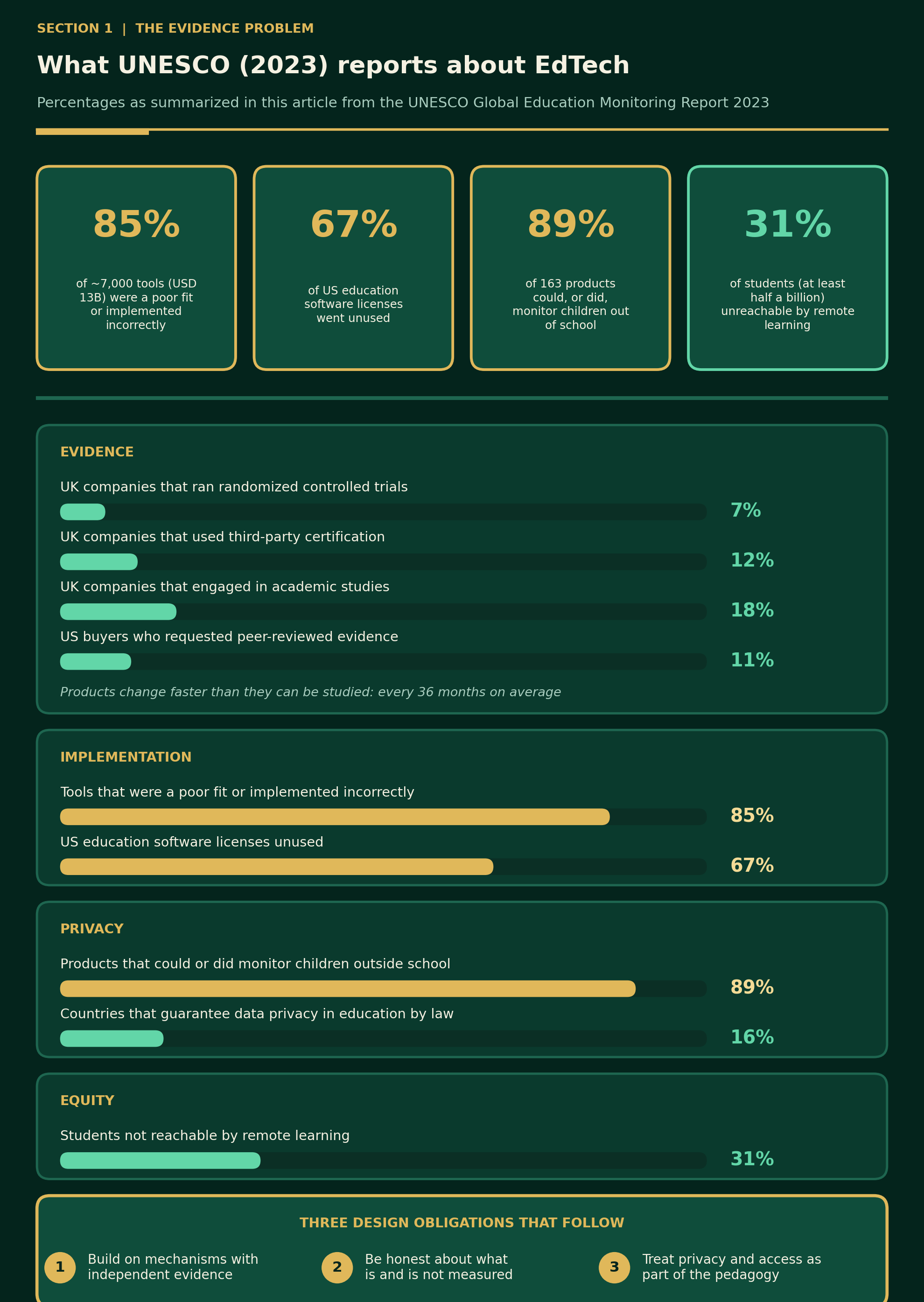
On evidence, the report notes that few companies test their products: in the United Kingdom, only 7% of education technology companies had run randomized controlled trials, while 12% had used third-party certification and 18% had engaged in academic studies. Buyers rarely demand more. In a survey of teachers and administrators in 17 US states, only 11% requested peer-reviewed evidence before adopting a technology. Products also change faster than they can be studied, on average every 36 months. Where reviews exist, they find small-to-medium positive effects compared with traditional instruction, with evaluations often failing to isolate the technology's contribution.
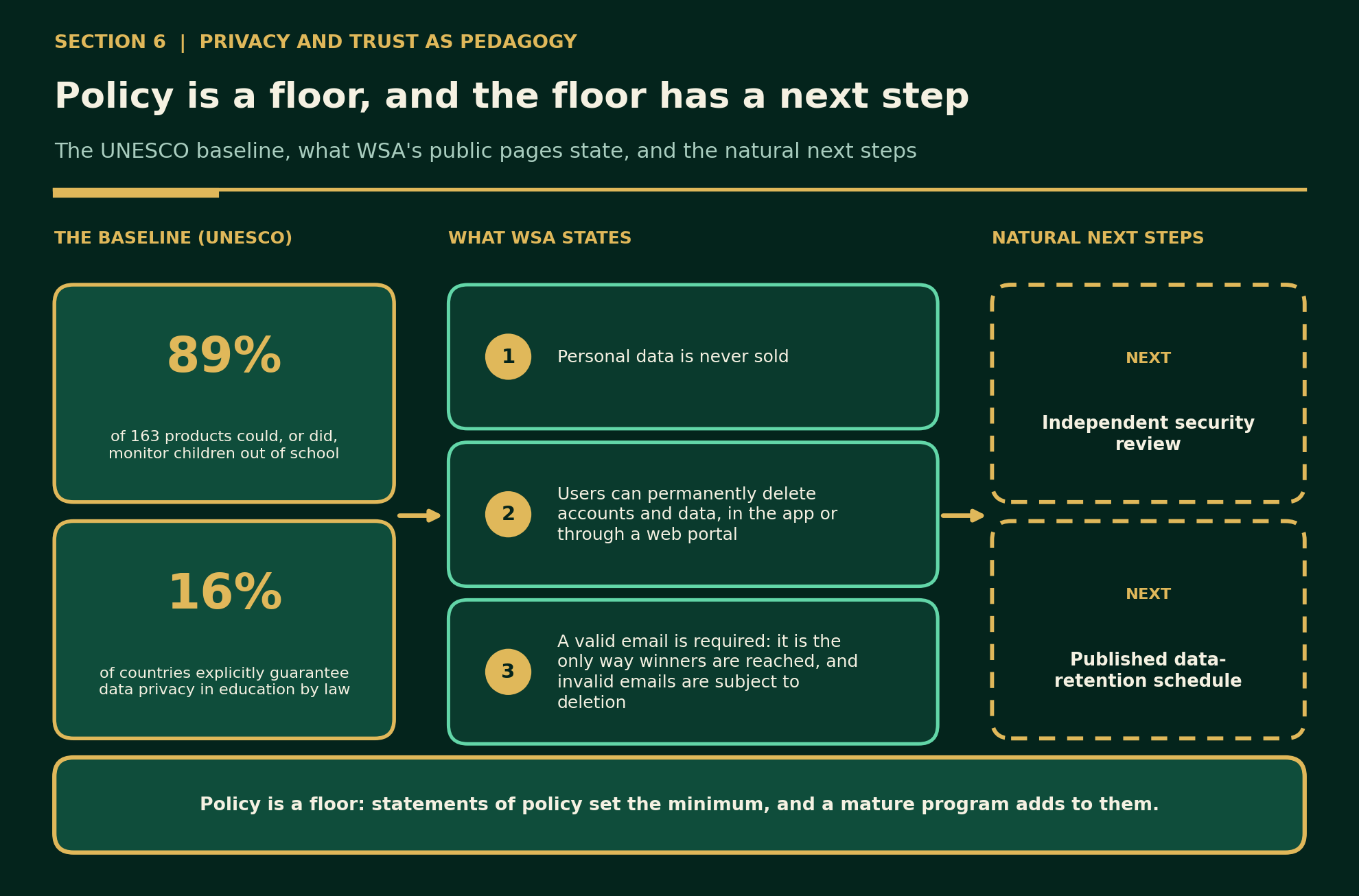
On implementation, the report cites an analysis in which 85% of roughly 7,000 pedagogical tools, costing USD 13 billion, were either a poor fit or implemented incorrectly, and an average of 67% of education software licenses in the United States went unused. On privacy, one analysis found that 89% of 163 education technology products recommended during the pandemic could, or did, monitor children outside school hours, and only 16% of countries explicitly guarantee data privacy in education by law. On equity, at least half a billion students (31% worldwide) could not be reached by remote learning during school closures.
A tool is only as good as the mechanism it carries, the evidence behind that mechanism, and the terms on which it reaches the learner.
Three design obligations follow. A platform should be built on mechanisms with independent evidence. It should be honest about what it has and has not measured. It should treat privacy and access as part of the pedagogy, not an appendix. The rest of this article applies those obligations.
2. Four mechanisms that survive scrutiny
2.1 Retrieval practice
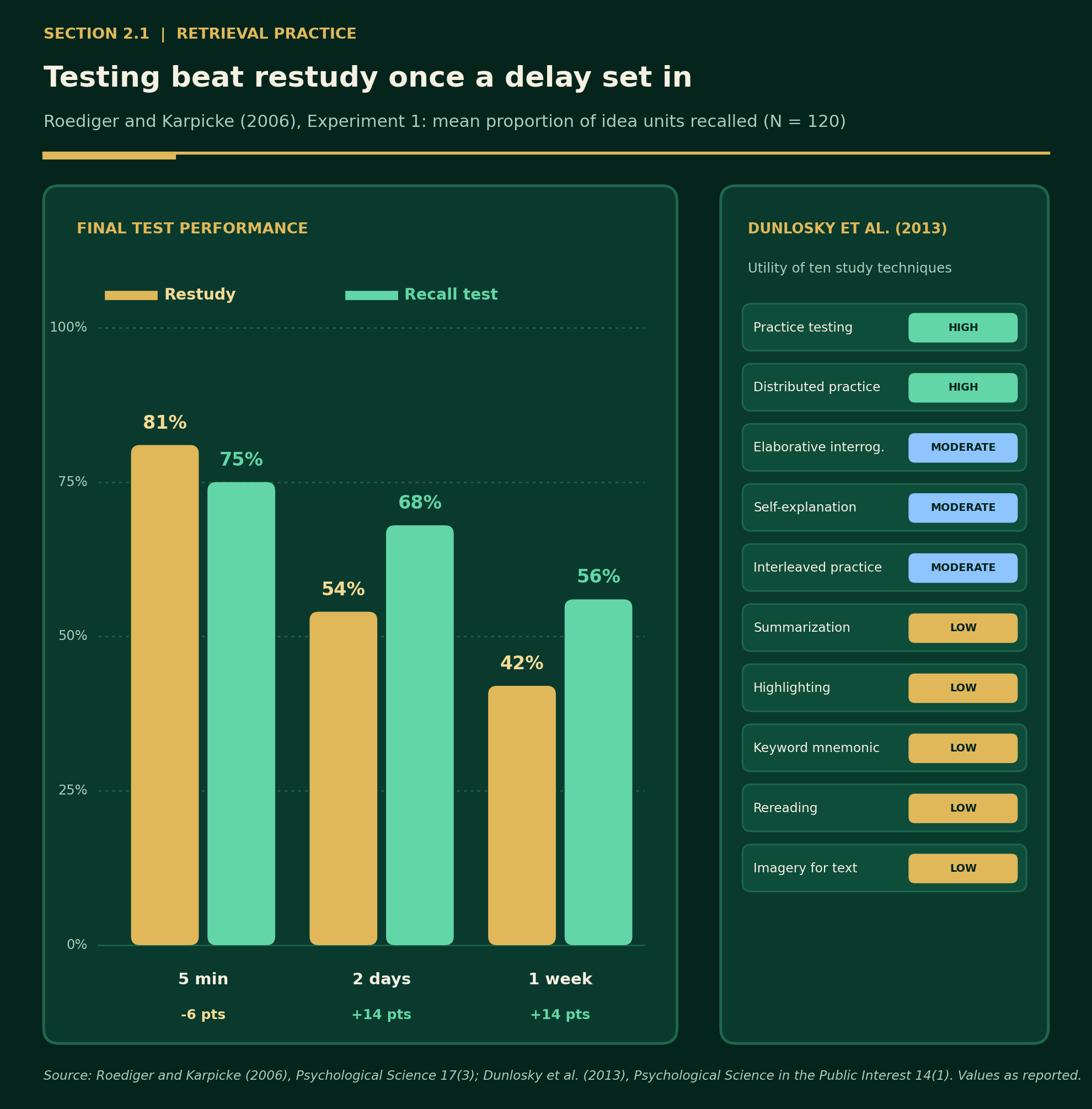
In a widely cited pair of experiments, Roediger and Karpicke (2006) had students study prose passages and then either take a recall test or restudy the material. After five minutes, restudying produced better results. After two days and after one week, prior testing produced substantially greater retention, even though students who had restudied felt more confident that they would remember. The finding has since been replicated broadly, and it carries a design implication that is easy to state and hard to honor: the act of retrieving an answer is itself a learning event, not merely a measurement of one.
Dunlosky and colleagues (2013) reviewed ten common study techniques and rated practice testing and distributed practice as highly useful, while rating familiar habits such as rereading and highlighting as low. A product that asks learners to produce answers, rather than watch explanations, therefore aligns with the stronger side of that ledger.
2.2 Distributed practice
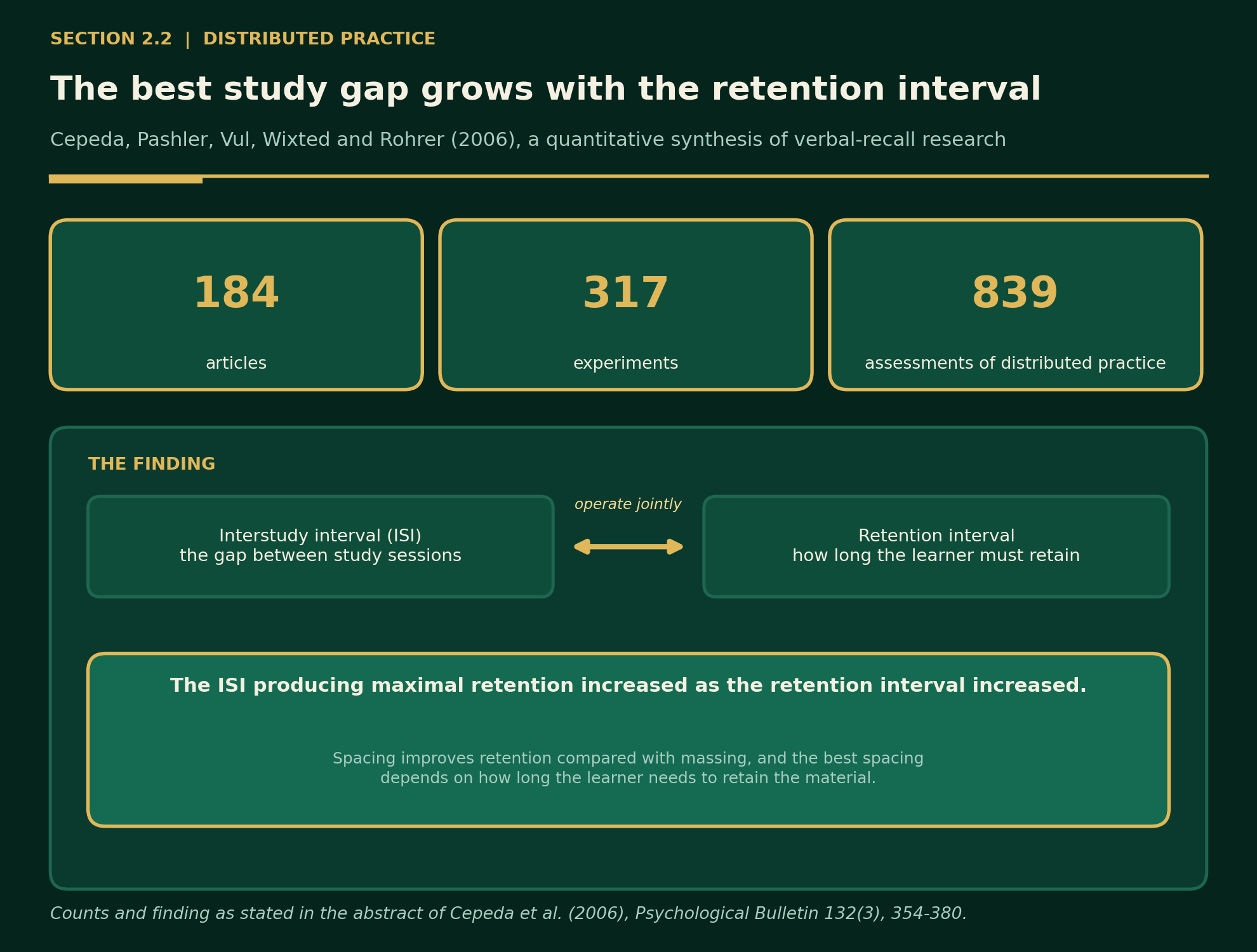
Cepeda and colleagues (2006) reviewed the distributed-practice literature on verbal recall and found that spreading study across time reliably improves retention compared with massing it, and that the best spacing depends on how long the learner needs to retain the material. A daily cadence does not by itself implement optimal spacing for any single fact. Instead, it creates the habit of returning, which is the precondition for any spacing schedule to work. The distinction matters, and it is revisited in the limitations below.
2.3 Responsive tutoring
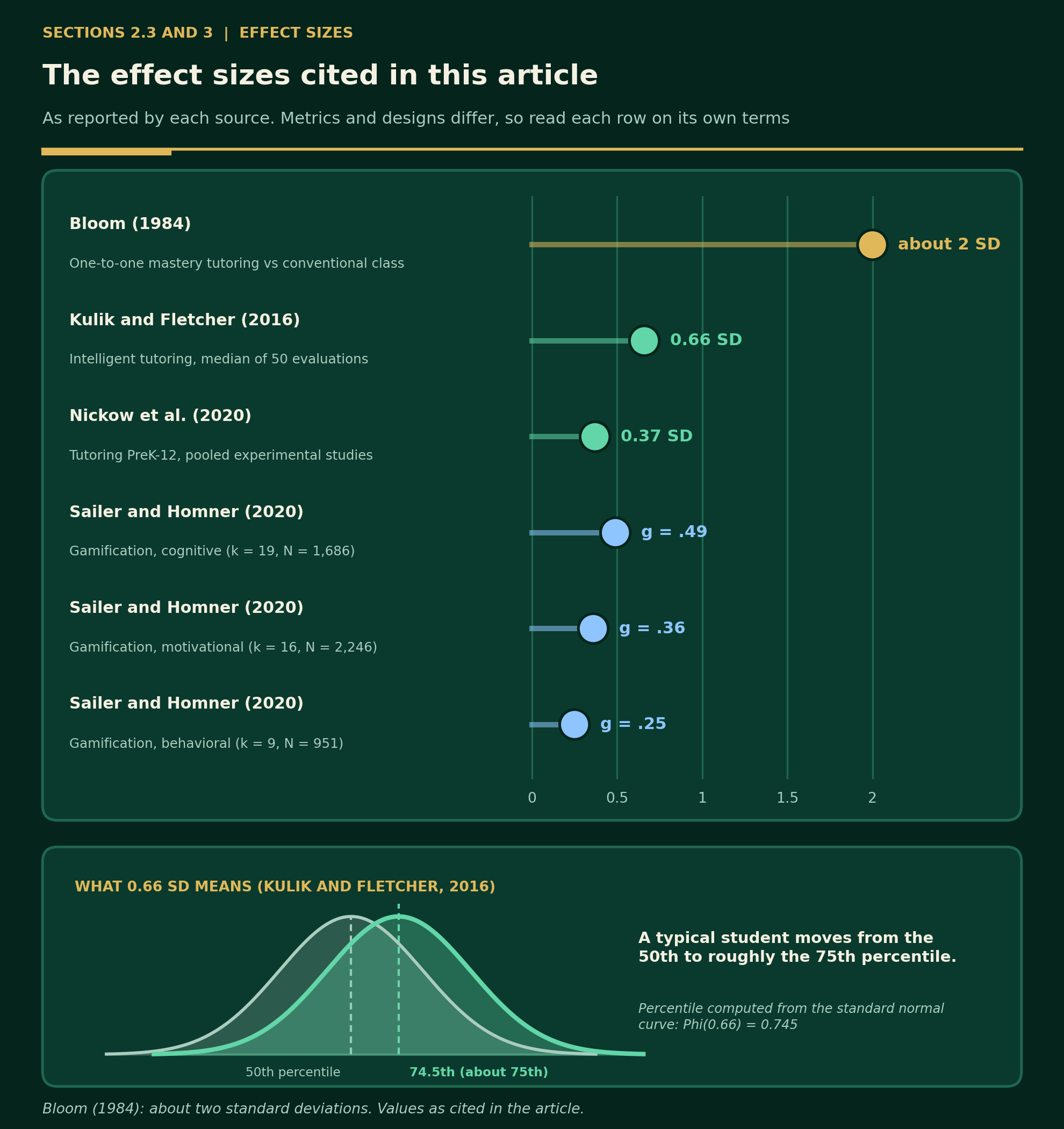
Bloom (1984) reported that students taught one-to-one with mastery learning performed about two standard deviations better than students in conventional classes, and framed the result as a problem: the search for group-instruction methods as effective as one-to-one tutoring. Later work has been more conservative. Nickow, Oreopoulos, and Quan (2020), pooling experimental studies of tutoring from pre-kindergarten through grade 12, reported a pooled effect of about 0.37 standard deviations, still large by education research standards. On the technology side, VanLehn (2011) found that intelligent tutoring systems approached the effectiveness of human tutoring, and Kulik and Fletcher (2016), in a meta-analysis of 50 controlled evaluations, found a median effect of 0.66 standard deviations, which moves a typical student from the 50th to roughly the 75th percentile. They also found that results depended on whether the outcome test was locally developed or standardized, a reminder that alignment between instruction and assessment inflates apparent gains.
The point for design is not that every product must be a tutor. Personalization, immediate feedback, and calibrated difficulty are among the few features with a consistent record, and effect sizes should always be read with the test-and-control condition in view.
2.4 Motivation that lasts
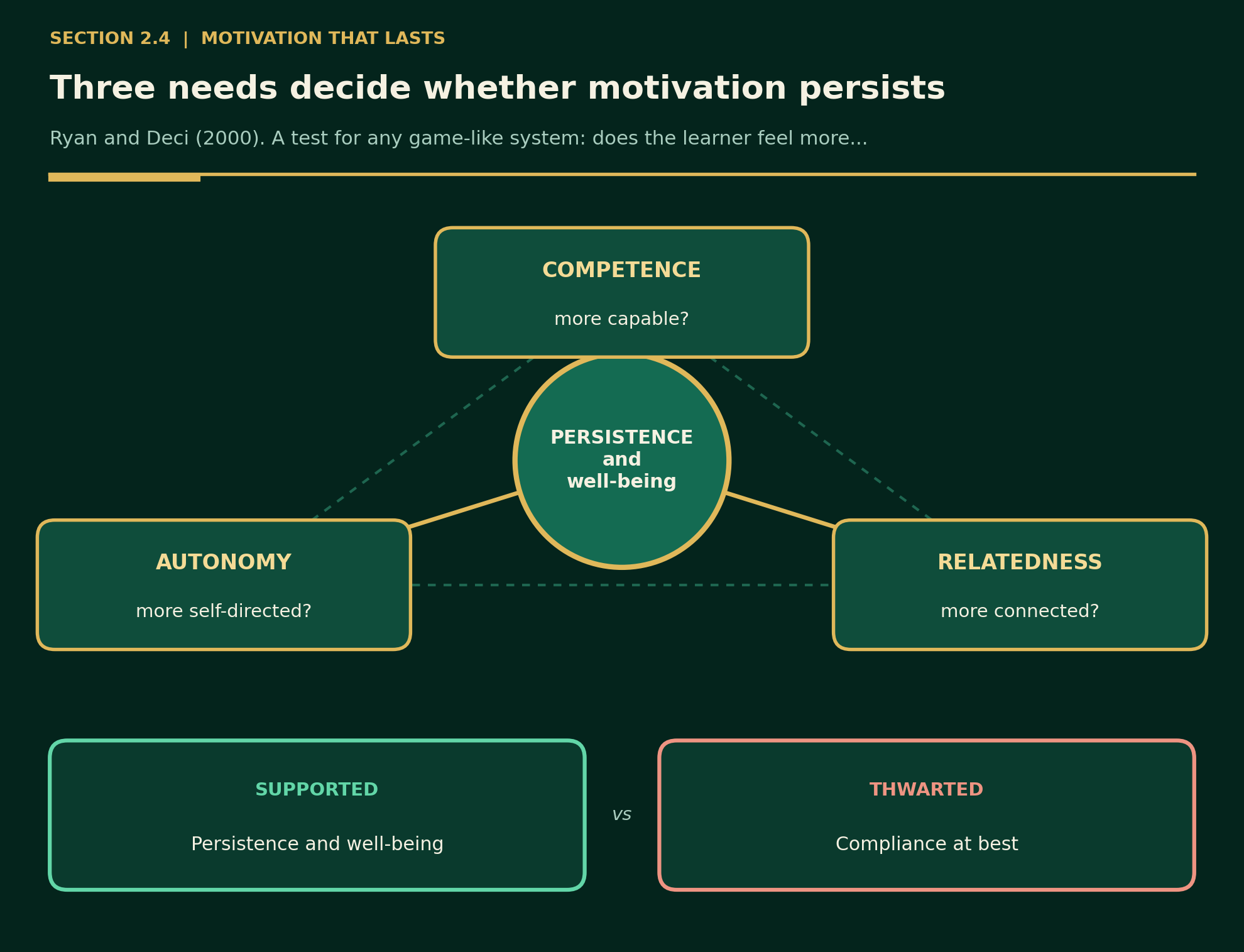
Self-determination theory proposes that sustained, high-quality motivation depends on three needs: competence, autonomy, and relatedness (Ryan and Deci, 2000). Environments that support these needs tend to produce persistence and well-being; environments that thwart them tend to produce compliance at best. This framing helps evaluate any game-like system because it asks a question that points and badges do not: does the learner feel more capable, more self-directed, and more connected after taking part?
3. Gamification and competition: small effects, real conditions
“Gamification” is conventionally defined as using game design elements in non-game contexts (Deterding et al., 2011). Early reviews found promising but mixed results and noted that outcomes depended strongly on context and users (Hamari, Koivisto and Sarsa, 2014). The most useful quantitative synthesis to date is the meta-analysis by Sailer and Homner (2020), which found significant but small positive effects of gamification on cognitive outcomes (g = .49, k = 19, N = 1,686), motivational outcomes (g = .36, k = 16, N = 2,246) and behavioral outcomes (g = .25, k = 9, N = 951).
Two readings of those numbers are possible, and an honest practitioner should hold both. The optimistic reading is that game elements, added to sound instruction, produce measurable gains in knowledge, drive, and behavior. The cautious reading is that these effects are small, that they come from a modest number of studies, and that they depend on how the elements are implemented. Neither reading licenses the claim that adding a leaderboard makes people learn.
The caution has a theoretical basis. In a meta-analysis of experiments on rewards and intrinsic motivation, Deci, Koestner and Ryan (1999) found that tangible rewards that are expected and contingent tended to undermine intrinsic motivation. A competitive platform with prizes therefore carries a design risk, not only a design opportunity. The responsible response is to make the learning itself the thing worth returning for, to keep any prize modest relative to the intrinsic payoff, and to measure what happens.
4. World Scholars Arena as a design instance
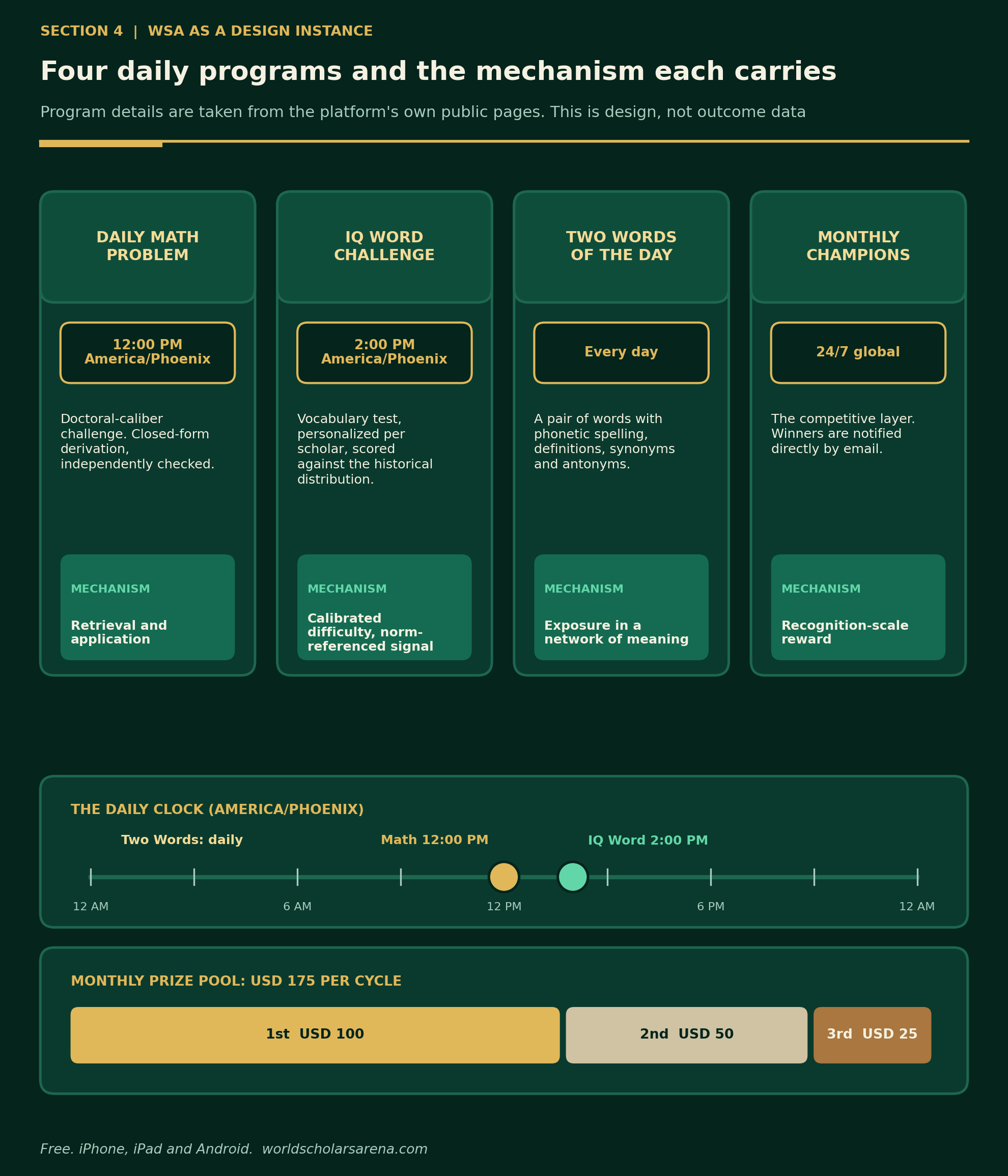
WSA describes itself as a global competitive intelligence platform, built “to measure academic excellence, sharpen reasoning, and reward disciplined daily practice” (World Scholars Arena, home page). It is free, runs on iPhone, iPad, and Android, and aims to democratize access to elite intellectual competition. The product is organized around four daily programs. The following description relies on what those program pages say, not on outcomes data.
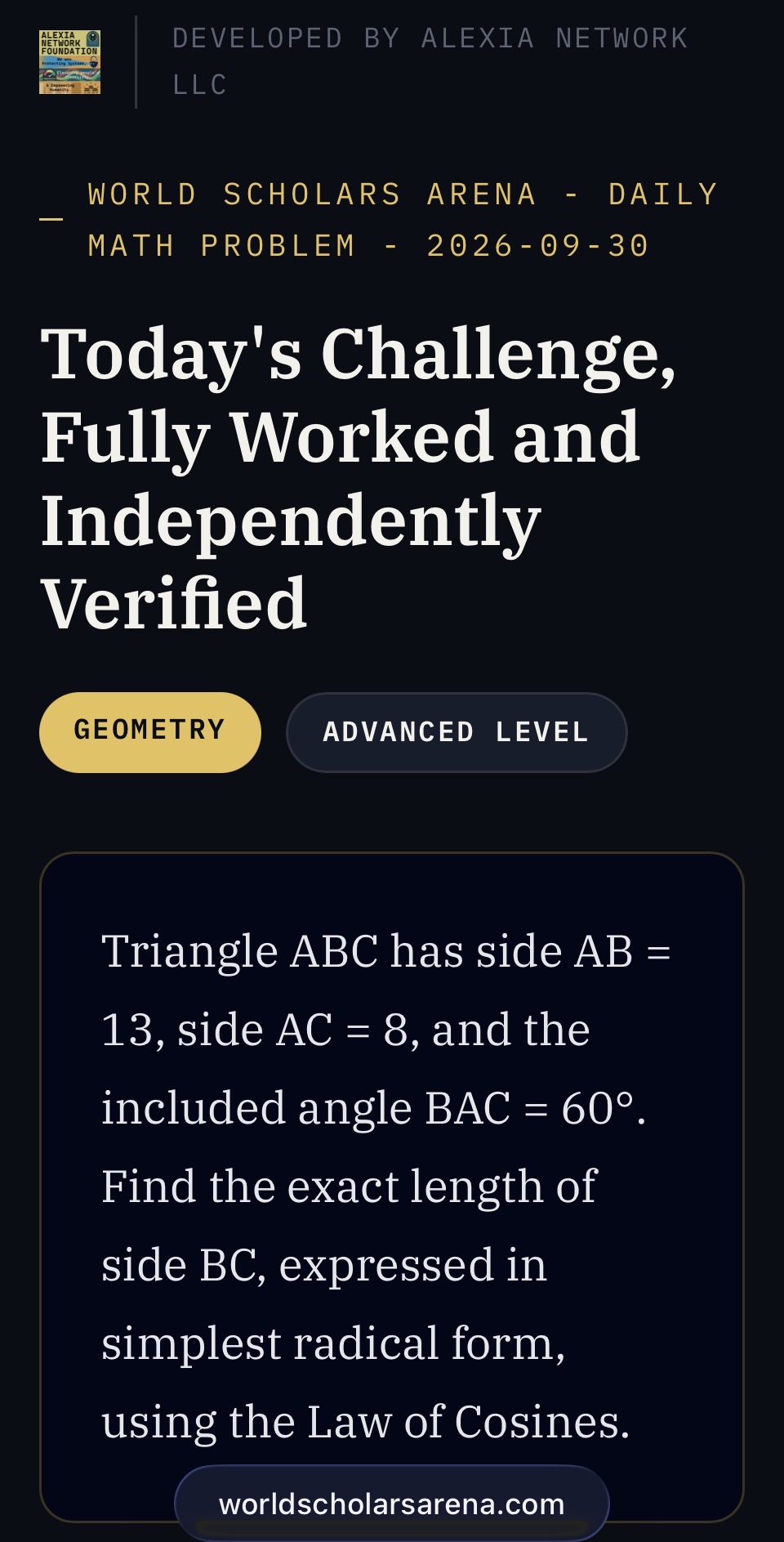
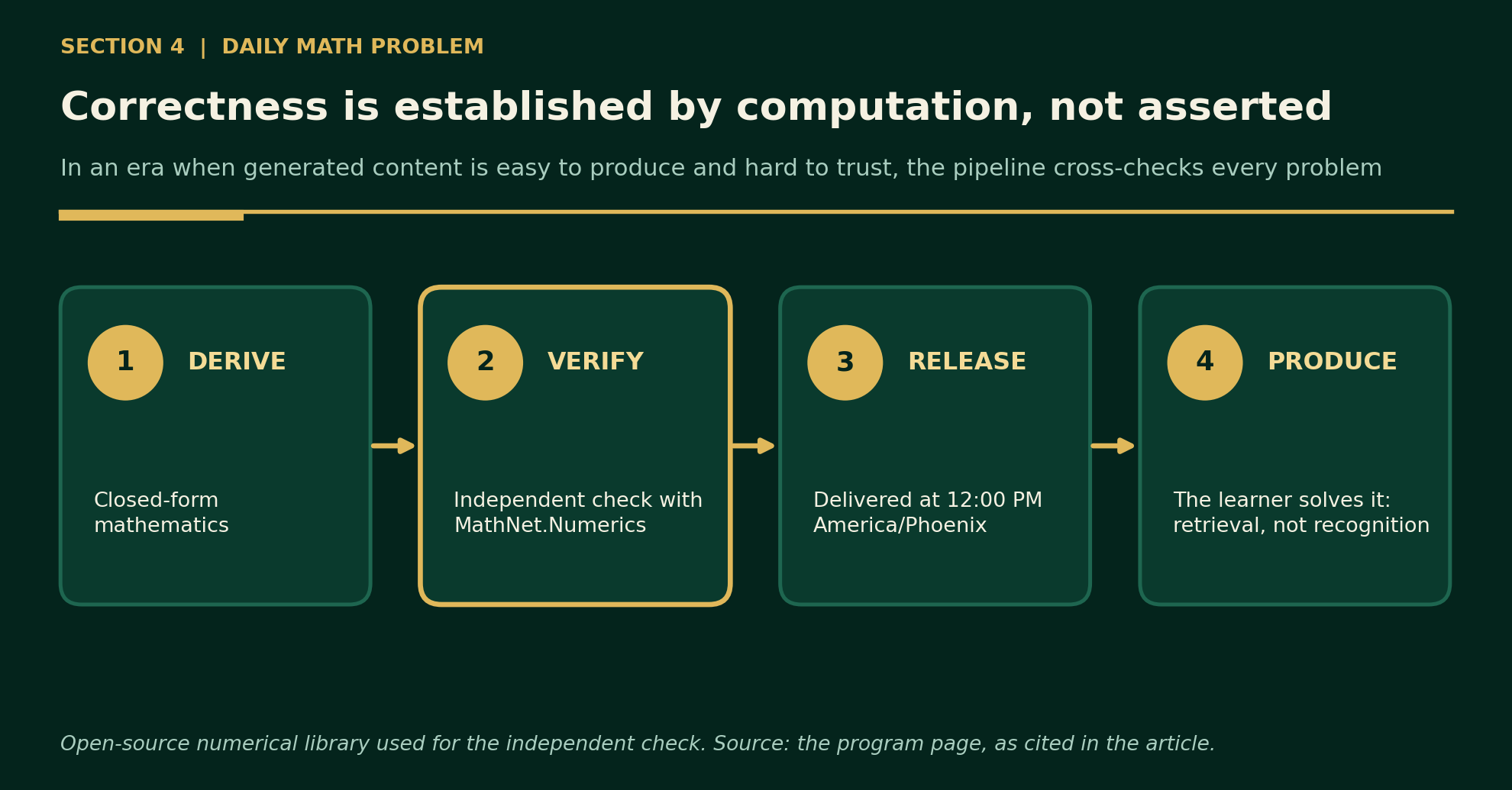
The Daily Math Problem is described as a doctoral-caliber challenge. Its most distinctive design feature is verification. The program page states that each problem is derived by closed-form mathematics and independently checked with MathNet.Numerics, an established open-source numerical library (World Scholars Arena, home page). In an era when generated content is easy to produce and hard to trust, a pipeline in which correctness is established by computation and cross-checked, rather than asserted, is a design choice with real consequences for learner trust. It also maps directly to the retrieval and application mechanism in section 2.1: the learner must produce a solution, not recognize one.
The IQ Word Challenge is a vocabulary test delivered daily at 2:00 PM America/Phoenix. The page describes it as personalized for each scholar and scored against the historical distribution of attempts (World Scholars Arena, home page). Two features deserve note. Personalization aligns with the tutoring literature’s emphasis on calibrated difficulty (section 2.3). Scoring against a historical distribution gives the learner a norm-referenced signal of where they stand, which can support the competence need in self-determination theory when it is informative and can undermine it when it is only ranking. Which of these occurs is an empirical question WSA should study.
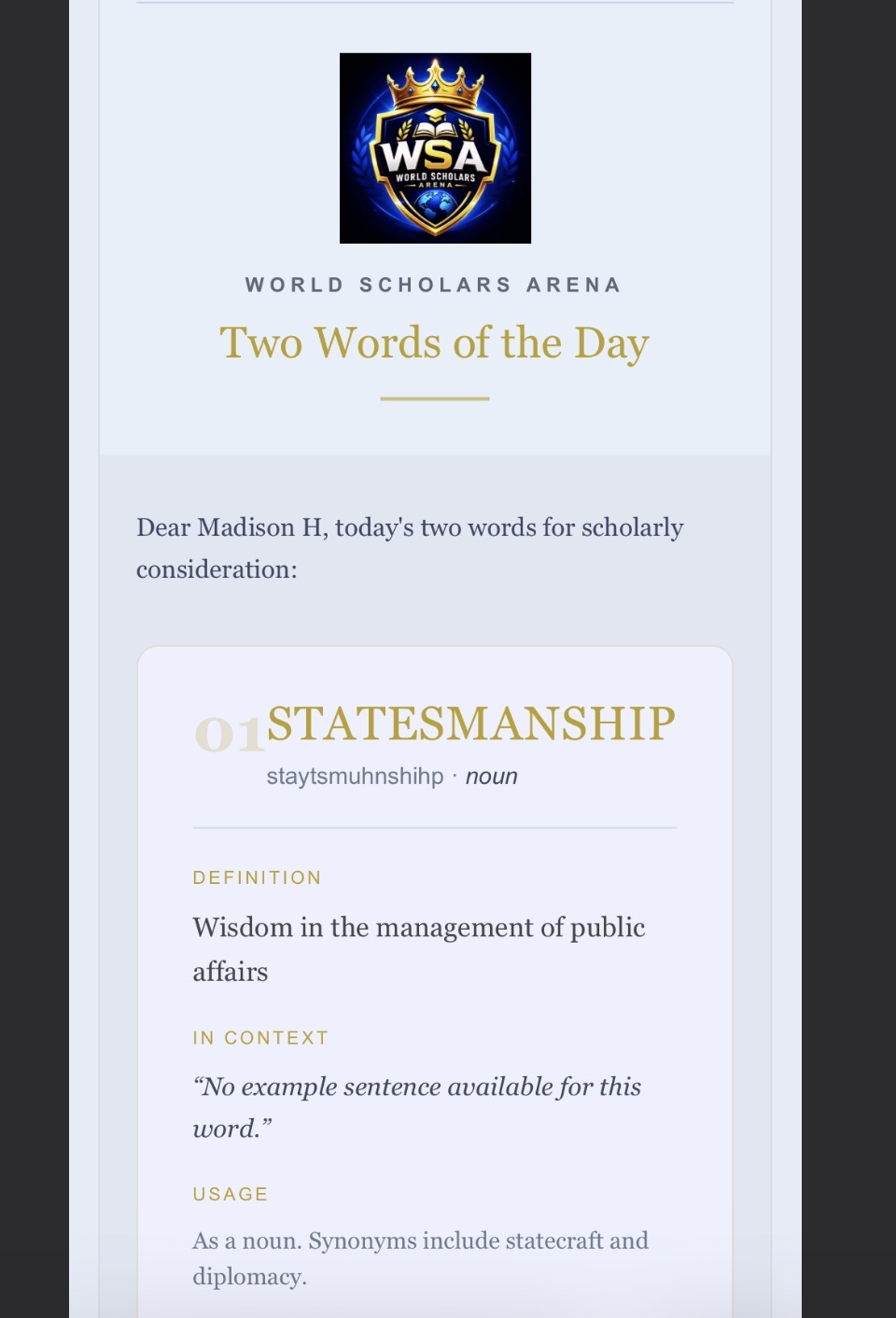
Two Words of the Day presents a pair of vocabulary words each day, with phonetic spelling, definitions, and synonym and antonym relationships (World Scholars Arena, home page). Presenting words in relation to their neighbors in meaning, rather than as isolated items, is a sound instructional instinct. By itself, it is exposure, not retrieval, and its value rises when paired with the IQ Word Challenge, which asks the learner to use what was seen.
Monthly Champions is the competitive layer. The platform describes a 24/7 global competition with USD 175 awarded each cycle: USD 100 for first place, USD 50 for second and USD 25 for third, with winners notified directly by email (World Scholars Arena, home page). The prize pool is small by design, which, as Deci, Koestner, and Ryan (1999) argue, is a defensible choice: large enough to signal recognition and small enough that it is unlikely to be the reason anyone solves a problem.
5. What the design gets right, and what it has not yet shown
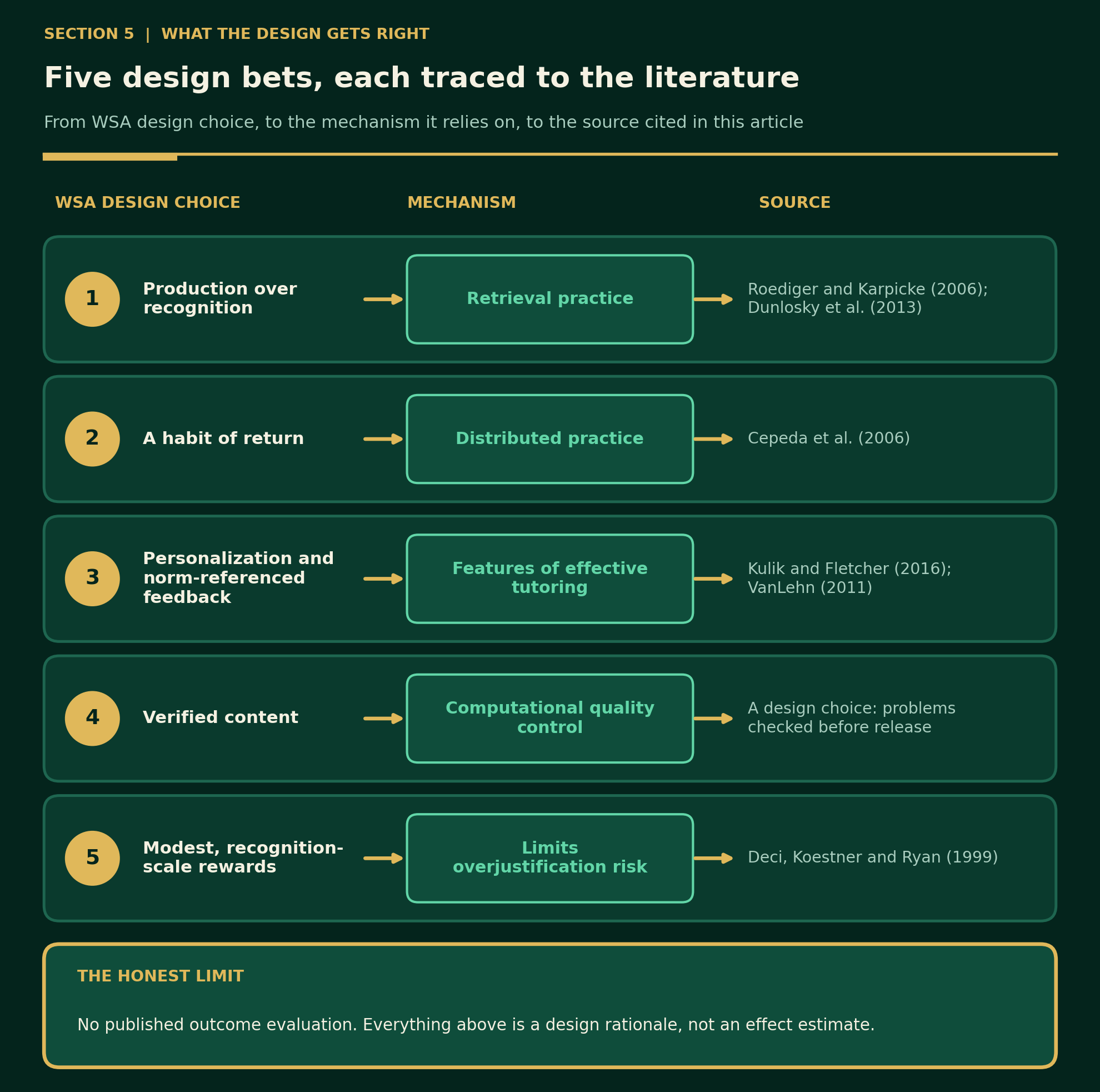
Taken together, the four programs make a coherent set of bets, each traceable to the literature.
- Production over recognition. Daily problems and challenges demand answers, the central requirement of retrieval practice (Roediger and Karpicke, 2006; Dunlosky et al., 2013).
- A habit of return. A fixed daily cadence creates the conditions for distributed practice to work (Cepeda et al., 2006).
- Personalization and norm-referenced feedback. Personalized challenges and distribution-based scoring echo the features that distinguish effective tutoring systems (Kulik and Fletcher, 2016; VanLehn, 2011).
- Verified content. Computational verification of problems protects learners from errors, a quiet but consequential form of quality control.
- Modest, recognition-scale rewards. A small prize pool limits the risk of overjustification (Deci et al., 1999).
The limitations are equally concrete, and stating them is part of the scholarly obligation.
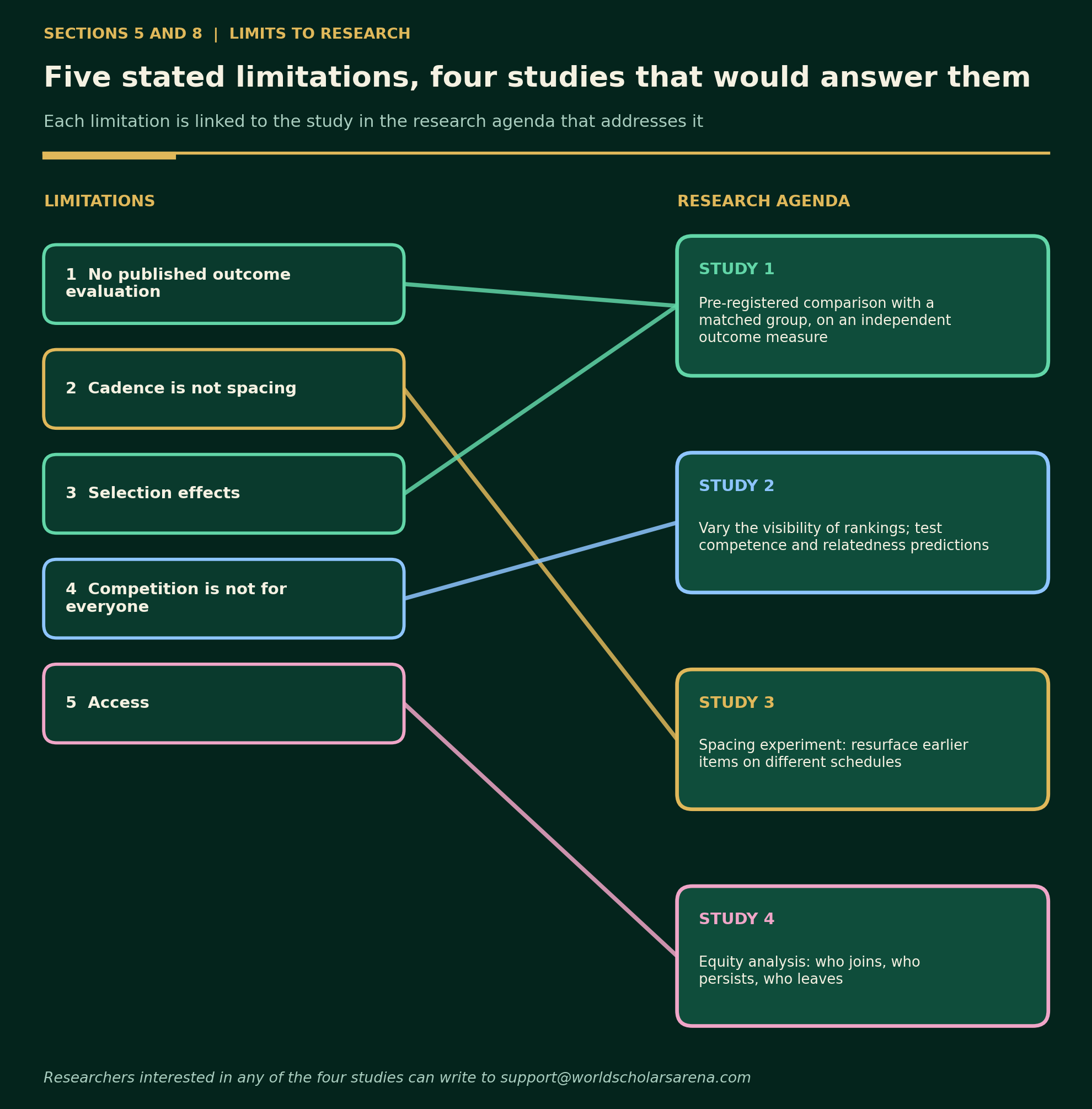
- No published outcome evaluation. WSA has not yet published a study showing that regular participation improves measured learning. Everything above is a design rationale, not an effect estimate. The correct next step is a pre-registered evaluation with a defined comparison condition, a validated outcome measure independent of the platform’s own scoring, and attention to the alignment problem that Kulik and Fletcher (2016) identify.
- Cadence is not spacing. A daily program supports returning, but optimal spacing is item-specific and depends on retention interval (Cepeda et al., 2006). Whether WSA should resurface earlier items on an expanding schedule is a promising design question.
- Selection effects. People who choose a daily competitive platform are not a random sample of learners. Any raw comparison of participants with non-participants will overstate benefits.
- Competition is not for everyone. Rank-based comparison can motivate some learners and discourage others. Self-determination theory predicts it will help when it supports competence and hurt when it thwarts it, so the design should be tested across learner groups, not averaged.
- Access. The platform runs on phones and requires a valid email. That serves many learners and excludes others. UNESCO’s equity findings, including the 31% of students unreachable by remote learning during school closures, remind us that a free product is not the same as an accessible one (UNESCO, 2023).
6. Privacy and trust as pedagogy
UNESCO’s privacy findings, summarized above, set a baseline that any education product aimed at learners should meet, stated in plain language. WSA’s public pages state that personal data is never sold, that users can permanently delete their accounts and data from within the app or through a web portal, and that a valid email is required because it is the only way winners are reached, with accounts using invalid emails subject to deletion (World Scholars Arena, home page). These are statements of policy, and policy is a floor. A mature program would add independent security review and a published data-retention schedule; both are natural next steps for any platform in this field.
7. How Alexia Network is fostering the field
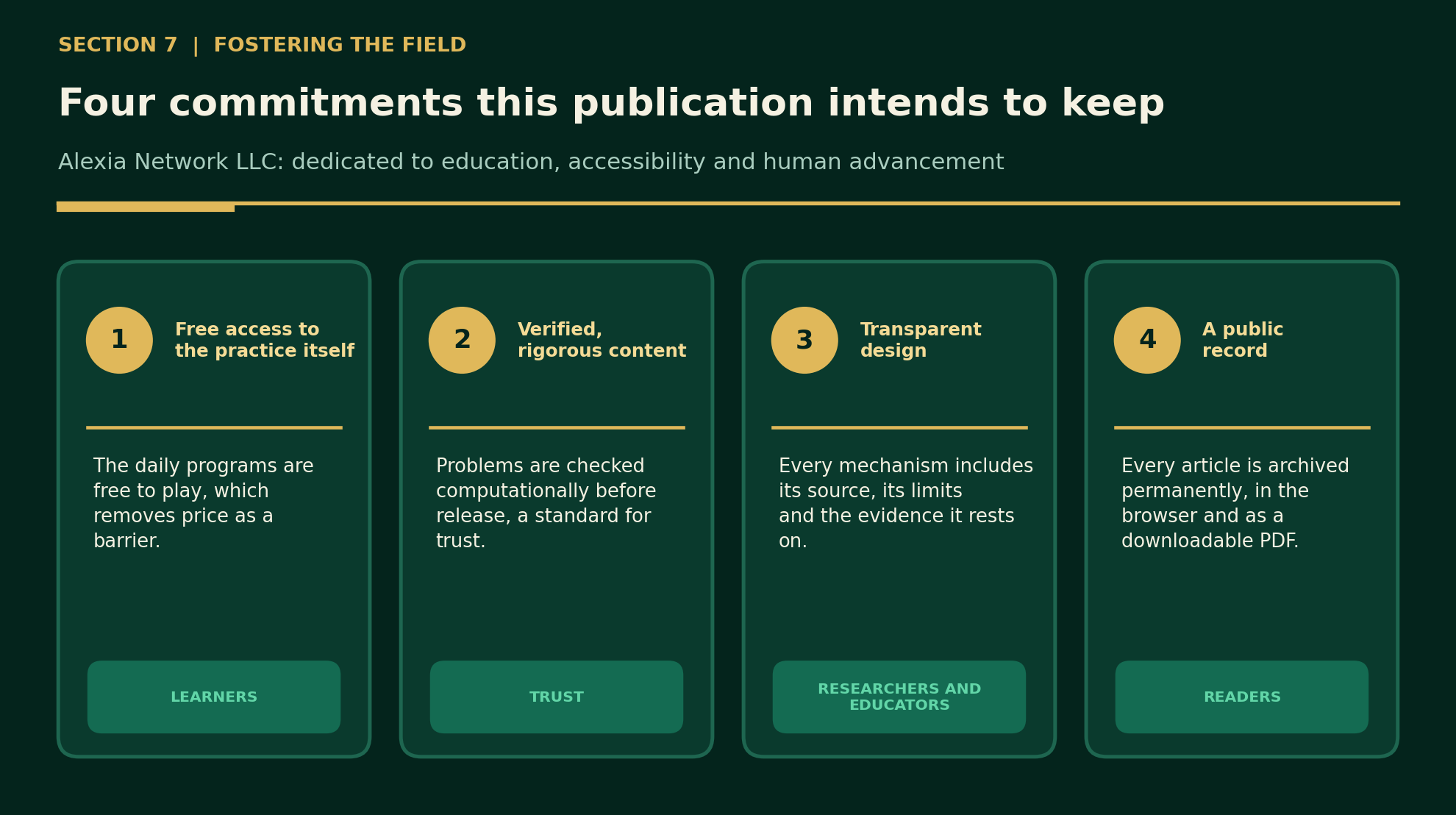
Alexia Network LLC describes itself as a privately held technology company dedicated to education, accessibility, and human advancement (World Scholars Arena, home page). Its contribution to the field, if it earns one, will not come from claims. It will come from four commitments that this publication intends to keep.
- Free access to the practice itself. The daily programs are free to play, which removes price as a barrier for the learners the platform reaches.
- Verified, rigorous content. We check problems computationally before release, setting a standard for trust in an era of cheap generated content.
- Transparent design. Every mechanism described here includes its source, its limits, and the evidence it rests on, so researchers and educators can judge it and, if warranted, test it.
- A public record. The Alexia Network Publication archives every article permanently, in the browser and as a downloadable PDF, so that its claims can be checked against what it said at the time (archive).
8. Conclusion and a research agenda
The strongest case for daily competitive education technology is not that games are fun. It is that a well-built daily practice loop can deliver retrieval, distribution, and personalization at scale, at no cost to the learner, and that a modest competitive layer can help people keep returning. The strongest case against it is that gamification effects are small, that reward structures can backfire, and that platforms rarely publish evidence. The responsible position holds both.
Four studies would move the claims in this article from plausible to demonstrated: a pre-registered comparison of regular WSA participants with a matched comparison group on an independent outcome measure; an experiment varying the visibility of rankings to test the competence and relatedness predictions of self-determination theory; a spacing experiment that resurfaces earlier items on different schedules; and an equity analysis of who joins, who persists, and who leaves. Researchers interested in any of them can write to support@worldscholarsarena.com.
Play now, or register
The fastest way to understand a practice platform is to practice on it.
- Play now: start with today's challenges at worldscholarsarena.com/home. Playing is how you sign up.
- Download and register: free on the App Store and Google Play, or see all download options. Register with a valid email so that monthly winners can be reached.
- Read the programs: Daily Math Problem, IQ Word Challenge and Monthly Champions.
- Privacy and terms: Privacy Policy and Terms of Service.
References
Bloom, B. S. (1984). The 2 sigma problem: The search for methods of group instruction as effective as one-to-one tutoring. Educational Researcher, 13(6), 4-16. doi:10.3102/0013189X013006004
Cepeda, N. J., Pashler, H., Vul, E., Wixted, J. T., and Rohrer, D. (2006). Distributed practice in verbal recall tasks: A review and quantitative synthesis. Psychological Bulletin, 132(3), 354-380. doi:10.1037/0033-2909.132.3.354
Deci, E. L., Koestner, R., and Ryan, R. M. (1999). A meta-analytic review of experiments examining the effects of extrinsic rewards on intrinsic motivation. Psychological Bulletin, 125(6), 627-668. doi:10.1037/0033-2909.125.6.627
Deterding, S., Dixon, D., Khaled, R., and Nacke, L. (2011). From game design elements to gamefulness: Defining "gamification". Proceedings of the 15th International Academic MindTrek Conference, 9-15. doi:10.1145/2181037.2181040
Dunlosky, J., Rawson, K. A., Marsh, E. J., Nathan, M. J., and Willingham, D. T. (2013). Improving students' learning with effective learning techniques. Psychological Science in the Public Interest, 14(1), 4-58. doi:10.1177/1529100612453266
Hamari, J., Koivisto, J., and Sarsa, H. (2014). Does gamification work? A literature review of empirical studies on gamification. Proceedings of the 47th Hawaii International Conference on System Sciences, 3025-3034. doi:10.1109/HICSS.2014.377
Kulik, J. A., and Fletcher, J. D. (2016). Effectiveness of intelligent tutoring systems: A meta-analytic review. Review of Educational Research, 86(1), 42-78. doi:10.3102/0034654315581420
Nickow, A., Oreopoulos, P., and Quan, V. (2020). The impressive effects of tutoring on PreK-12 learning: A systematic review and meta-analysis of the experimental evidence (NBER Working Paper 27476). doi:10.3386/w27476
Roediger, H. L., and Karpicke, J. D. (2006). Test-enhanced learning: Taking memory tests improves long-term retention. Psychological Science, 17(3), 249-255. doi:10.1111/j.1467-9280.2006.01693.x
Ryan, R. M., and Deci, E. L. (2000). Self-determination theory and the facilitation of intrinsic motivation, social development, and well-being. American Psychologist, 55(1), 68-78. doi:10.1037/0003-066X.55.1.68
Sailer, M., and Homner, L. (2020). The gamification of learning: A meta-analysis. Educational Psychology Review, 32, 77-112. doi:10.1007/s10648-019-09498-w
UNESCO. (2023). Global education monitoring report 2023: Technology in education: A tool on whose terms? UNESCO. gem-report-2023.unesco.org
VanLehn, K. (2011). The relative effectiveness of human tutoring, intelligent tutoring systems, and other tutoring systems. Educational Psychologist, 46(4), 197-221. doi:10.1080/00461520.2011.611369
World Scholars Arena. (2026). Home page. worldscholarsarena.com
Atem Astor Tangap. Published by Alexia Network LLC, the software company behind World Scholars Arena, an educational competition platform for iPhone and Android.
© 2026 Alexia Network LLC. All rights reserved. Images and text are protected by copyright.
Join World Scholars Arena
Put the ideas in this article to work
Play now
Start with today's Daily Math Problem and IQ Word Challenge. Playing is how you sign up: your first score puts you on the board.
Play nowDownload and register
Free for iPhone, iPad and Android. Register with a valid email so the monthly winners can be reached.
All download optionsStay informed
Comments 0